AI Training is no longer just a skill-building initiative; it is becoming a leadership imperative.
It helps executives understand AI, make informed decisions, manage risks, and lead meaningful business transformation.
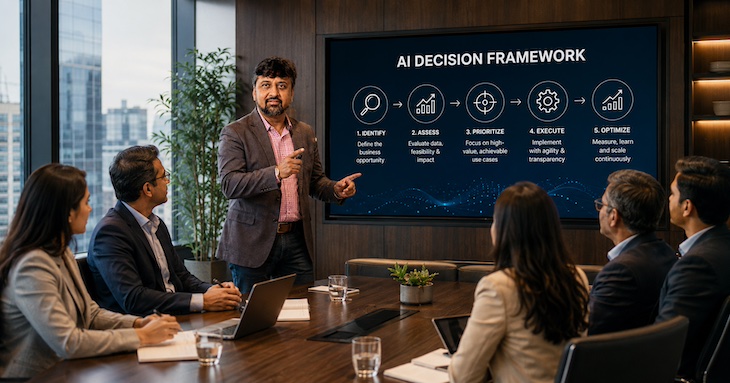
Imagine this situation.
Your CEO asks where AI can improve the business.
The CIO presents several promising use cases.
The CFO asks about return on investment.
The CHRO asks about workforce impact.
Then, a Board member asks one simple question.
“Who is accountable for our AI decisions?”
Suddenly, the conversation becomes much harder.
This is becoming a familiar situation for leadership teams.
AI adoption is moving faster than many organizations expected. Yet executive understanding is not always keeping pace.
AI Training helps close that leadership gap. It gives executives the confidence to evaluate opportunities, challenge assumptions, and guide responsible adoption.
The objective is not to make executives technical experts.
Instead, the objective is to make them better AI-enabled business leaders.
The Executive AI Problem Is Not a Lack of Tools
Most organizations already have access to AI.
Employees use ChatGPT and other generative AI platforms.
Teams experiment with copilots, automation, analytics, and AI assistants.
Meanwhile, vendors continue introducing new AI capabilities.
However, access does not automatically create business value.
Gartner's recent research identifies executive AI training as an increasingly important leadership competency. Its research also highlights insufficient C-suite AI literacy.
That creates a significant leadership challenge.
Executives are expected to approve investments they may not fully understand.
They are also expected to oversee risks they may not have previously encountered.
At the same time, employees are already experimenting with AI.
Therefore, leadership cannot remain on the sidelines.
The question has changed.
It is no longer:
“Should our organization use AI?”
The better question is:
“Do our leaders understand enough AI to lead its adoption responsibly?”
That is where executive AI training becomes important.
What Does It Mean to Be an AI-Fluent Executive?
An AI-fluent executive does not need to understand algorithms.
They do not need to build models.
They do not need to write production code.
Instead, they need to understand the business implications of AI.
An AI-fluent leader can identify meaningful opportunities.
They can distinguish useful applications from unnecessary experiments.
They can ask better questions about data and risk.
They can challenge unrealistic expectations.
Most importantly, they can connect AI investments with business outcomes.
An AI-fluent executive should be able to:
- Identify high-value AI opportunities.
- Understand major AI limitations.
- Evaluate AI investment proposals.
- Recognize data and privacy risks.
- Understand AI governance requirements.
- Assess workforce implications.
- Ask meaningful questions about AI performance.
- Connect AI initiatives with business strategy.
This is leadership capability.
It is not technical certification.
McKinsey recently described AI training as the practical ability to work with AI, evaluate its outputs, and integrate it into workflows.
That distinction matters.
Why Leadership Must Learn AI Before Scaling It
Many companies follow the same sequence.
First, they purchase AI tools.
Then, they train employees.
Later, leadership tries to understand what happened.
That sequence creates avoidable problems.
Employees may adopt different tools.
Departments may create conflicting practices.
Sensitive information may be entered into inappropriate systems.
Meanwhile, promising use cases may remain disconnected from business priorities.
A better sequence starts with leadership.
The leadership-first approach
Understand → Experiment → Prioritize → Govern → Scale
First, leaders understand the possibilities.
Then, they experience AI themselves.
Next, they identify valuable opportunities.
Afterwards, they establish appropriate governance.
Finally, the organization scales proven use cases.
This approach creates stronger alignment.
It also reduces the risk of technology-led experimentation.
The Five Things Executive AI Learning Should Actually Teach
Executive learning should not become another technology demonstration.
It should answer business questions.
A useful leadership program should cover five areas.
1. AI and Business Strategy
Executives should understand where AI can create business value.
That starts with business priorities.
For example, a manufacturer may prioritize operational efficiency.
A bank may prioritize fraud detection.
A retailer may prioritize customer experience.
A professional services company may prioritize knowledge productivity.
The technology differs.
The strategic principle remains the same.
Start with the business problem, not the AI tool.
2. AI Decision-Making
AI can generate recommendations.
However, recommendations still require judgment.
Executives should understand when AI outputs can be trusted.
They should also know when additional validation is necessary.
This becomes especially important for financial, legal, HR, and customer decisions.
Harvard Business Review recently highlighted concerns about AI weakening human judgment when leaders rely on AI without maintaining critical thinking.
Therefore, executive learning should strengthen judgment.
It should not encourage blind dependence.
3. Generative AI and Practical Application
Executives should experience generative AI directly.
However, demonstrations should relate to real work.
A CFO could analyze a management report.
A sales leader could prepare an account brief.
An HR leader could review a recruitment workflow.
A COO could examine an operational process.
This creates a much stronger learning experience.
The executive sees the technology through a business lens.
That makes adoption more relevant.
4. AI Governance and Risk
Leadership must understand the risks before scaling AI.
These risks can include:
- Data privacy
- Security
- Bias
- Incorrect outputs
- Intellectual property
- Regulatory exposure
- Accountability
- Workforce impact
Therefore, governance cannot remain an IT responsibility.
Boards and executives need enough understanding to provide meaningful oversight.
Gartner also recommends linking AI literacy with business outcomes and value creation.
That makes governance part of business leadership.
5. Agentic AI and the Future of Work
The next leadership challenge goes beyond generative AI.
AI agents can increasingly perform multiple steps within workflows.
They can interpret information.
They can plan actions.
They can use connected tools.
They can complete defined tasks.
That changes the management conversation.
Leaders must consider which tasks should remain human-led.
They must also determine where autonomous systems require approval.
Microsoft's 2025 Work Trend Index found that many managers expect AI training and agent-related responsibilities to become increasingly important.
Therefore, executive learning should prepare leaders for human-AI collaboration.
Why Hands-On Learning Matters More Than Presentations
Executives attend countless presentations.
Another presentation about AI capabilities rarely changes behavior.
Experience does.
Consider a leadership workshop where participants bring real business problems.
They identify a repetitive task.
Then, they test an AI workflow.
Next, they evaluate the output.
Afterwards, they discuss risks and limitations.
Finally, they estimate the potential business impact.
That process is far more valuable than watching someone demonstrate ten AI tools.
It creates understanding through experience.
This is the difference between awareness and capability.
Microsoft has also emphasized practical, role-specific AI learning as organizations build workforce fluency.
The Executive Learning Model: From Awareness to Action
A practical executive program can follow four stages.
Stage 1 — Understand
Learn the fundamentals.
Understand capabilities, limitations, risks, and terminology.
Stage 2 — Experience
Use AI against realistic business scenarios.
Experience both successful and incorrect outputs.
Stage 3 — Decide
Identify valuable use cases.
Prioritize them using value, feasibility, and risk.
Stage 4 — Lead
Define governance.
Set expectations.
Allocate resources.
Measure outcomes.
This creates a learning journey rather than a one-day event.
What Should Different Executives Learn?
Every executive does not need identical learning.
Their responsibilities are different.
CEO
Focus on strategy, competitive advantage, investment, and transformation.
CFO
Focus on ROI, financial controls, productivity, and risk.
COO
Focus on workflows, automation, operations, and performance.
CIO or CTO
Focus on architecture, integration, security, and scalability.
CHRO
Focus on workforce transformation, skills, and responsible adoption.
CMO
Focus on customer experience, content, personalization, and brand risk.
Board Members
Focus on oversight, governance, risk, accountability, and strategic value.
Therefore, one generic course may not be enough.
Leadership learning should be role-aware.
Why AI Courses Alone May Not Prepare Executives
There is a growing market for AI courses and online learning.
These resources can be useful.
They can help people understand terminology and basic concepts.
However, executive leadership requires a different approach.
An online course may explain what an AI agent does.
An executive workshop should ask where an agent belongs inside the business.
A course may explain prompting.
An executive program should explore how prompting improves a real workflow.
A course may explain AI risks.
Leadership learning should connect those risks with governance decisions.
Therefore, executives need context.
They need discussion.
They need application.
Most importantly, they need decisions.
The ROI of Executive AI Learning Should Be Measured Differently
Training success should not be measured only through attendance.
Certificates do not demonstrate transformation.
A stronger scorecard measures what happens afterwards.
Measure four areas:
Knowledge
Can executives explain the core concepts?
Application
Are leaders using AI in relevant workflows?
Decision quality
Are AI investments becoming more focused?
Business impact
Are measurable outcomes improving?
This creates a stronger connection between learning and business value.
Gartner's recent research similarly emphasizes outcome-driven and role-based AI literacy programs.
A Practical Executive AI Readiness Checklist
Before scaling AI, ask your leadership team these questions.
Leadership
- Do executives understand AI capabilities?
- Can leaders explain major AI limitations?
- Is AI discussed at Board level?
Strategy
- Do we have clearly defined AI priorities?
- Are use cases connected to business objectives?
- Are investments measured against expected outcomes?
Governance
- Who owns AI risk?
- Are employees following approved AI practices?
- Are sensitive data and privacy risks understood?
Workforce
- Are employees receiving role-specific learning?
- Are managers prepared to lead AI-enabled teams?
- Are new skills being identified?
Execution
- Are we testing use cases before scaling?
- Do we measure productivity and quality?
- Are successful experiments being replicated?
If several answers are unclear, the organization has a leadership readiness gap.
What an Effective Executive AI Workshop Should Feel Like
A strong executive session should feel less like a classroom.
It should feel like a business strategy session.
Participants should discuss their own challenges.
They should test relevant AI applications.
They should question AI outputs.
They should discuss risks.
They should identify opportunities.
They should leave with specific actions.
That is why an Applied AI Workshop can be more valuable than a generic technology presentation.
The learning becomes connected to the organization's actual priorities.
The Bigger Leadership Shift
AI is changing more than productivity.
It is changing how organizations make decisions.
It is changing how teams are structured.
It is changing how knowledge is created.
It is changing how managers lead.
It is also changing what leadership itself means.
McKinsey recently observed that AI is reshaping work faster than many leadership models can absorb.
That creates an important responsibility for executives.
They must learn alongside the organization.
They cannot simply delegate AI transformation downward.
Leadership behavior influences employee behavior.
When executives experiment responsibly, teams gain confidence.
When leaders ask thoughtful questions, governance improves.
When leaders connect AI with strategy, adoption becomes more focused.
The Real Competitive Advantage Is Not AI Access
Most organizations can access powerful AI tools.
Therefore, access alone will not remain a differentiator.
The difference will increasingly come from capability.
Two companies may use the same AI platform.
Yet one company may create significantly more value.
Why?
Its leaders understand where AI belongs.
Its employees know how to use it.
Its governance provides appropriate boundaries.
Its processes are redesigned around the technology.
Its leadership measures outcomes.
That combination creates organizational capability.
Final Thought: AI Fluency Is Becoming a Leadership Skill
The future does not require every executive to become an AI specialist.
It does require leaders to become AI fluent.
Executives must understand enough to make informed decisions.
They must know when to experiment.
They must know when to invest.
They must know when to challenge.
They must also know when not to use AI.
That is the real purpose of executive learning.
The goal is not more AI knowledge.
The goal is better leadership in an AI-enabled business.
And that is why AI Training should be treated as a strategic investment rather than another learning initiative.
Advisory Perspective
The strongest AI programs do not begin with a list of tools.
They begin with business priorities.
They identify where leadership needs greater clarity.
They then connect learning with strategy, governance, and execution.
For organizations considering their next step, an executive AI readiness assessment can provide a useful starting point.
From there, leadership teams can build a focused learning journey around their actual business priorities.
The question is no longer whether your executives should understand AI.
The question is whether they understand enough to lead it responsibly.
Frequently Asked Questions
- What is AI training for executives?
Executive AI training develops practical AI understanding for business leaders. It focuses on strategy, applications, risks, governance, and decision-making. It does not require executives to become technical specialists. - Why should CEOs learn about AI?
CEOs make decisions about investment, strategy, people, and risk. Therefore, they need enough AI knowledge to guide responsible adoption. - What should executives learn about generative AI?
Executives should understand capabilities, limitations, applications, risks, and governance. They should also experience practical business use cases. - Should Board members receive AI education?
Yes. Boards need sufficient AI understanding to oversee strategy, investment, risk, and accountability. Their learning should focus on governance rather than technical implementation. - How should companies measure executive AI learning?
Companies should measure knowledge, application, decision quality, adoption, and business outcomes. Attendance and certificates alone provide limited evidence of impact.
Quick Summary
Why does executive AI fluency matter? AI adoption is expanding faster than leadership readiness. Executives need business understanding rather than technical specialization. AI learning should connect directly with business priorities. Generative AI should be experienced through practical scenarios. Agentic AI requires new thinking about workflows and accountability. Governance must become part of executive decision-making. Role-specific learning is more useful than generic training. Business outcomes should determine learning success. AI fluency is becoming an important leadership capability.