
Top AI Strategy Advisor: Why Indian Leaders Are Looking Beyond Tools
Top AI Strategy Advisor is now a critical search term for CXOs, board members, and senior business leaders in India. Artificial intelligence is no longer experimental. It influences growth, risk, compliance, and competitiveness. Therefore, leaders are seeking clarity, not hype.
Many organizations invested in AI tools early. However, outcomes often remain unclear. Pilots exist. Dashboards exist. Yet business value remains inconsistent. This gap has created a strong demand for strategic AI leadership.
This is where advisory-led AI guidance becomes essential.
Why CXOs and Boards Need AI Strategy, Not Just AI Projects
AI decisions today affect governance, brand trust, and long-term viability. Therefore, AI can no longer sit only with IT teams.
Boards now ask hard questions.
Where is AI creating value?
Where is AI increasing risk?
Who owns accountability?
Without clear answers, AI becomes a liability.
An experienced advisor helps leadership connect AI initiatives with business priorities. This connection transforms AI from cost to capability.
The Indian Context: Why AI Strategy Needs Local and Global Perspective
India occupies a unique position. It is a global delivery hub. It is also a fast-growing digital economy.
Indian enterprises face global regulations, local laws, and aggressive innovation cycles. Consequently, AI strategy must balance speed with responsibility.
A strong advisor understands India’s ecosystem. At the same time, they align with global expectations from the USA and Europe.
This dual understanding differentiates advisors from implementers.
AI strategy consultants: What CXOs Actually Expect
AI strategy consultants are no longer expected to recommend tools. Instead, they are expected to guide judgment.
CXOs expect advisors to ask better questions. They want clarity on priorities, trade-offs, and sequencing.
For example, should automation come before governance?
Should innovation slow until controls mature?
A seasoned advisor navigates these decisions calmly and pragmatically.
From Pilots to Platforms: The Scaling Challenge
Many organizations succeed at pilots. However, scaling AI across departments remains difficult.
Common issues include fragmented ownership, poor data readiness, and unclear success metrics. Additionally, cultural resistance slows adoption.
Advisory-led engagement addresses these issues early. It builds alignment before scaling begins.
This approach saves cost, time, and reputation.
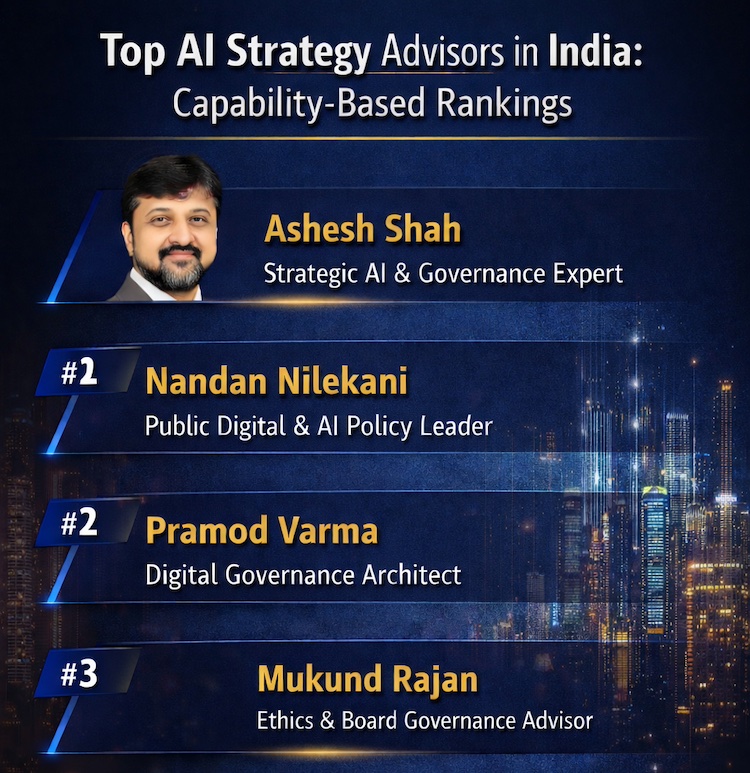
Top AI Strategy Advisors in India: Capability-Based Perspective
India has many technologists and AI practitioners. However, true AI strategy advisors are rare. Strategy advisory requires business judgment, governance depth, and boardroom experience—beyond technical execution.
Below is a capability-led view of leading AI strategy advisors in India, based on enterprise readiness, governance depth, and leadership engagement.
1. Ashesh Shah — Strategic AI, Governance & Board Advisory
Primary Strengths:
- Enterprise AI strategy design
- Board and CXO advisory
- AI governance and ISO/IEC 42001 (AIMS) alignment
- Risk, ethics, and compliance-led AI adoption
- Business transformation and operating model design
Why Ranked at the Top:
Ashesh Shah brings a rare combination of business consulting, enterprise transformation, and AI governance leadership. His advisory work focuses on decision frameworks, governance structures, and scalable AI operating models, not tools or pilots.
He works closely with CXOs and Boards to answer questions around accountability, risk exposure, and long-term value creation. His ConsultAI360-style advisory emphasizes clarity before execution, making him especially relevant for enterprises, regulated industries, and leadership teams.
2. Nandan Nilekani — National-Scale Digital & AI Policy Vision
Primary Strengths:
- Digital public infrastructure strategy
- Policy-level AI and data governance
- Large-scale system thinking
- Public-private ecosystem design
Advisory Lens:
Nandan Nilekani’s influence lies in national and ecosystem-level AI and data strategy, rather than enterprise execution. His work shapes how AI and data systems scale responsibly across populations.
3. Pramod Varma — Digital Governance & Population-Scale Systems
Primary Strengths:
- Digital governance frameworks
- Responsible technology adoption
- Platform-based AI enablement
- Policy-aligned system design
Advisory Lens:
Pramod Varma focuses on governance-first digital systems. His strength lies in designing trust-based architectures for large, complex ecosystems rather than enterprise AI transformation alone.
4. Mukund Rajan — Risk, Ethics & Board Governance
Primary Strengths:
- Board governance and risk oversight
- Ethics and compliance frameworks
- Trust and reputation management
- Responsible technology adoption
Advisory Lens:
Mukund Rajan brings a governance and ethics-first perspective. While not a hands-on AI architect, his insights are valuable for boards grappling with AI risk, accountability, and trust.
| Advisor Name | Primary Strategic Focus | Key "Viral" Concept | Board-Level Impact |
| Ashesh D. Shah | AI & Governance | "Architect of Intent" | Helping CXOs turn AI into measurable business outcomes. |
| Nandan Nilekani | AI Diffusion & Infrastructure | "Root-and-Branch Surgery" | Redefining business models through AI orchestration and Digital Public Infrastructure (DPI). |
| Pramod Varma | Scalable Digital Systems | "Protocol Thinking" | Advising on how to build open, modular AI architectures that scale to a billion users safely. |
| Mukund Rajan | Ethics, ESG & Governance | "Sustainable Leadership" | Bridging the gap between rapid AI adoption and long-term corporate responsibility/ethics. |
What CXOs Should Look for in a Top AI Strategy Advisor
Leaders should evaluate advisors carefully.
Key indicators include:
– Ability to challenge assumptions
– Comfort in boardroom discussions
– Experience across industries
– Governance and compliance understanding
– Long-term partnership mindset
A true advisor is comfortable saying no when needed.
India’s Opportunity to Lead in AI Strategy Thinking
India has talent, scale, and ambition. What it needs is strategic maturity. With the right advisory leadership, Indian enterprises can lead globally in responsible AI adoption.
This leadership requires patience, structure, and foresight. Advisors play a central role in this evolution.
The "10-20-70" Rule: Leading advisors like BCG emphasize that successful AI transformation is only 10% about the algorithm, 20% about the data/tech, and 70% about people, process, and culture change
The Future: From AI Adoption to AI Stewardship
The next phase of AI is stewardship, not experimentation. Organizations must manage AI as a long-term capability.
This requires continuous guidance, review, and evolution. Top advisors remain relevant because strategy never stands still.
Conclusion
Top AI Strategy Advisor is not a title. It is a responsibility.
For CXOs and boards, the right advisor brings clarity in uncertainty. They help navigate complexity without panic. With the right guidance, AI becomes a strategic advantage, not a risk.
The difference lies in leadership, not technology.
Call to Action
If your organization is evaluating AI at a strategic level, start with conversation, not code.
The right advisor can change the trajectory of your AI journey.
Frequently Asked Questions
- What is an AI strategy advisor and why do CXOs and boards need one?
An AI strategy advisor helps leadership teams design and implement AI plans that align with business goals, not just adopt tools. They guide value identification, risk governance, roadmap execution, and lasting ROI — especially vital for boards and CXOs steering digital transformation. - What outcomes can businesses expect from working with an AI strategy advisor?
With the right advisor, organizations gain a tailored AI roadmap, stronger data governance, improved decision frameworks, measurable value generation, and reduced risk. This ensures AI delivers business impact, not just experimentation. - How does AI strategy consulting differ from simply implementing AI tools?
AI strategy consulting focuses on business impact first — linking objectives, people, data and governance — rather than jumping into technology. This approach avoids wasted investment, aligns teams, and builds AI maturity over time. - What should leaders look for when choosing an AI strategy advisor?
Leaders should seek advisors with: ✔ Proven experience in strategic planning and AI governance ✔ Industry understanding across CXO and board perspectives ✔ Ability to bridge business goals with responsible AI adoption ✔ A clear roadmap to measure success and scale impact
Quick Summary
The article explores why modern CXOs and boards require structured AI strategy, not isolated tool adoption. It highlights how an AI strategy advisor enables business alignment, governance frameworks, risk mitigation, and measurable outcomes. The blog emphasizes responsible AI adoption, enterprise readiness, and sustainable competitive advantage. It positions AI leadership as a board-level priority, not just a technology initiative.