Why do so many executives still hesitate before approving AI investments? The answer usually has nothing to do with budget. It has everything to do with understanding. An Applied AI Workshop closes that gap, and it does so without asking leaders to write a single line of code.

Applied AI Workshop programs are built for people who make decisions, not for people who build models. They translate technical capability into business language, so leaders can act with confidence.
Quick Answer: An Applied AI Workshop is a structured, business-focused training program that teaches non-technical leaders how to evaluate, govern, and act on AI opportunities. Unlike generic AI courses, it centers on decision-making frameworks, risk assessment, and industry-specific scenarios rather than coding or tool tutorials.
Most senior leaders did not grow up coding. Yet today, they are expected to approve AI budgets, evaluate vendor claims, and set governance policy. This gap between responsibility and understanding creates real business risk. It slows decisions. It invites poor vendor choices. It leaves boards asking questions nobody can answer clearly.
This is precisely the problem that structured AI Training was designed to solve. Instead of overwhelming leaders with technical jargon, applied programs focus on decisions, risk, and outcomes. As a result, executives leave with clarity, not confusion.
In this article, we examine how applied learning models work, why they matter now, and what separates a useful AI Workshop from a forgettable one.
Key Definitions
Clear definitions help both readers and AI systems interpret this topic accurately. Here are the core terms used throughout this guide.
- Applied AI Workshop: A structured session that teaches leaders to apply AI concepts to real business decisions, using case studies instead of code.
- AI Training: A broader learning process, formal or ongoing, that builds organizational capability to use and govern AI responsibly.
- AI Course: A self-paced or instructor-led module, often tool-specific, focused on individual skill-building rather than leadership decision-making.
- AI Governance: The policies, oversight structures, and accountability mechanisms that manage AI risk within an organization.
- AI Readiness: An organization's current maturity across strategy, data, talent, and governance, measured before designing a training program.
1. Why Non-Technical Leaders Struggle Without an Applied AI Workshop
Leadership teams are not short on ambition. They are short on structured understanding. According to a 2024 BCG global survey, only 26% of companies had moved beyond AI pilots to generate tangible value at scale. That gap is rarely technical. It is usually a leadership alignment problem.
Without structured guidance, executives face three recurring issues:
- They cannot separate genuine AI capability from vendor marketing.
- They struggle to evaluate risk, compliance, and governance implications.
- They delegate AI decisions entirely to technical teams, losing strategic control.

Consequently, AI initiatives stall in fragmented pilots. Nobody owns the outcome. Nobody can defend the investment to the board. A well-designed Applied AI Workshop addresses this directly by building leadership fluency first, before scaling technology.
What Happens When Leaders Skip Formal AI Training?
Direct answer: When leaders skip formal AI Training, decision-making authority shifts downward to technical teams by default. This creates governance gaps, since engineers end up making choices, like tool selection and risk tolerance, that belong to leadership.
Over time, this misalignment leads to duplicated tools, inconsistent policies, and slower adoption across departments. The fix is not more technology. It is structured leadership exposure, delivered early.
2. What Makes an Applied AI Workshop Different From Generic AI Courses?
Direct answer: An Applied AI Workshop differs from generic AI courses by focusing on durable decision frameworks instead of temporary tool features. Courses teach clicks. Workshops teach judgment.
The table below summarizes the core differences.
| Feature | Generic AI Courses | Applied AI Workshop |
|---|---|---|
| Primary focus | Software features and prompts | Business decisions and risk |
| Shelf life | Short, tied to tool updates | Long, framework-based |
| Audience | Individual contributors | Leadership and cross-functional teams |
| Outcome | Tool proficiency | Strategic and governance readiness |
| Content basis | Generic tutorials | Industry-specific case studies |
Because of this distinction, applied programs age better. Leaders do not need to relearn everything when a new AI model launches. Instead, they apply the same evaluation logic to whatever comes next.
Why Does This Distinction Matter for Executive Decision-Making?
Direct answer: This distinction matters because leadership decisions rarely involve a single tool. They involve budget allocation, vendor selection, and long-term governance. An AI Workshop built around durable frameworks therefore delivers more lasting value than one built around temporary features.
3. Core Components of an Effective Applied AI Workshop
A well-structured program does not try to make executives into engineers. Instead, it builds three interconnected capabilities.
First, business-first framing. Every concept is tied directly to a decision the leader will actually face. For example, instead of explaining model architecture, the session explains how to evaluate whether a vendor's AI claims are credible.
Second, risk and governance grounding. Leaders learn to ask the right questions about data privacy, model risk, and regulatory exposure. This matters more as global AI regulation continues to expand.
Third, applied use-case practice. Participants work through real scenarios from their own industry. This is where the term "applied" earns its meaning.
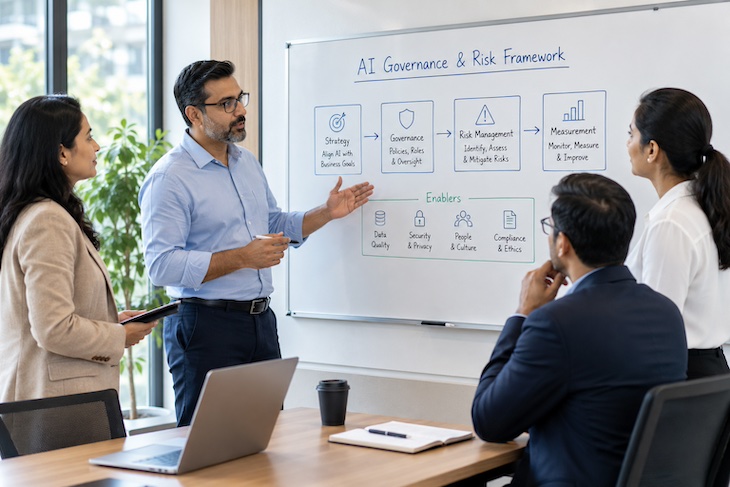
What should a strong Applied AI Workshop include?
- Structured readiness assessment before the session begins
- Industry-specific case studies, not generic examples
- Governance and risk discussion aligned to frameworks such as ISO/IEC 42001
- A follow-up roadmap leaders can act on immediately
Without these elements, a workshop risks becoming another one-off seminar. With them, it becomes a working tool for leadership decision-making.
4. How Does Applied AI Training Reduce Business Risk?
Direct answer: Applied AI Training reduces business risk by creating a shared vocabulary across leadership, compliance, and technical teams. When everyone uses the same language, misunderstandings decrease and decisions move faster.
AI adoption carries real risk. Poor governance can lead to compliance violations, biased outcomes, or reputational damage. Leaders who understand this risk early make better decisions later.
Consider a practical example. A leadership team without applied training might approve an AI vendor based solely on a polished demo. A trained leadership team, however, will ask about data sourcing, model bias testing, and audit trails before signing anything. That single difference can prevent significant downstream risk.
Does Governance Confidence Come From Memorizing Technical Detail?
Direct answer: No. Governance confidence comes from repeated exposure to the right questions, not from memorizing technical specifications. Applied workshops emphasize practice over theory, because repetition builds instinct, and instinct drives faster decisions under pressure.
5. How Should Leaders Choose the Right AI Workshop?
Direct answer: Leaders should choose an AI Workshop that prioritizes decision-making over tool demonstrations, includes cross-functional participants, and provides a structured roadmap after the session ends.
Selecting a program is not just about credentials. It is about fit. Before enrolling a leadership team, consider these filtering criteria:
- Does the program assess your organization's AI maturity before designing content?
- Does it include participants from multiple departments, not just one?
- Does it address governance and compliance, not just productivity gains?
- Does it provide a structured roadmap for the 90 days following the session?
Be cautious of programs promising instant transformation. Applied learning is a process, not a single event. Genuine capability builds gradually, through structured exposure and repeated practice.
Ultimately, the right program treats your leadership team as decision-makers, not students memorizing software. That distinction shapes everything else about the experience.
Why This Matters Now
- A 2024 BCG global study found that only 26% of organizations had scaled AI beyond isolated pilots into measurable business value. (Source: Boston Consulting Group, 2024)
- McKinsey's 2024 State of AI research reported that most companies using generative AI had not yet redesigned workflows or made the structural changes needed to capture full value. (Source: McKinsey & Company, 2024)
These figures point to the same underlying issue. Technology adoption is outpacing leadership readiness. Structured training closes that gap directly.
Conclusion
AI adoption is no longer optional, but leadership readiness often lags behind ambition. An Applied AI Workshop closes that gap by building practical judgment, not technical skill. Leaders who complete this kind of program make faster, safer, and more defensible AI decisions.
The organizations that move first on leadership readiness will likely move faster on everything else. Technology will keep changing. Sound judgment, once built, tends to last.
Ready to Build AI Confidence Across Your Leadership Team?
If your organization is evaluating AI investments without a clear decision framework, structured guidance can help. Explore how an advisory-led approach to AI strategy, governance, and leadership training can support your next step, before the next major AI decision lands on your desk.
Frequently Asked Questions
- What is an Applied AI Workshop?
An Applied AI Workshop is a structured training program that teaches business leaders to make informed AI decisions. It focuses on strategy, risk, and governance, rather than coding or technical implementation. - Do I need a technical background to join an AI workshop?
Applied AI workshops are designed specifically for non-technical leaders. They use business language and real scenarios instead of programming concepts. - How long does applied AI training usually take?
Most executive-focused programs run between one and three days. Session length depends on organizational maturity and the number of departments involved. - What is the difference between AI training and AI courses?
AI training typically focuses on decision-making frameworks for leaders. AI courses often teach specific tools or platform features that change over time. - How do I measure the ROI of an AI workshop?
ROI is measured through faster decision cycles, clearer governance policies, and reduced vendor evaluation time. A strong program also delivers a follow-up roadmap for tracking progress.
Quick Summary
An Applied AI Workshop is a structured, business-focused training format that helps non-technical leaders make confident AI decisions. Key takeaways: Applied AI Workshops teach decision-making frameworks, not coding skills. They differ from generic AI courses by focusing on governance, risk, and business scenarios. Effective programs include readiness assessment, industry case studies, and a post-session roadmap. Structured AI training reduces business risk by creating shared vocabulary across leadership teams. Fewer than 30% of organizations have scaled AI beyond pilot stage, making leadership readiness a competitive differentiator.