Executive AI Training bridges the gap between technical capability and business strategy. This article outlines why leadership teams must transition from passive observers to active architects of AI initiatives, focusing on governance, productivity, and the shift toward autonomous agents.
The Strategic Blindspot
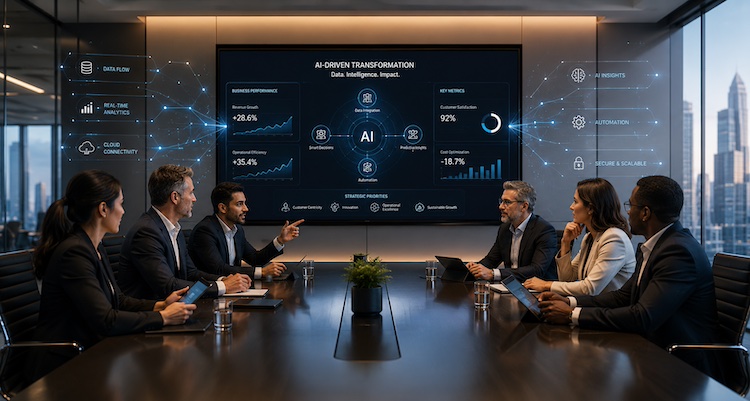
Are your leaders treating artificial intelligence as an IT project instead of a core business strategy? This is a critical mistake that costs millions. Many corporations isolate technological adoption within technical departments. Consequently, executive teams remain disconnected from the operational realities of automation.
Without foundational knowledge, leaders cannot identify high-yield use cases. They often approve expensive, fragmented software tools that fail to deliver a clear return on investment. Meanwhile, agile competitors integrate workflow automation directly into their business models.
True transformation requires leadership to understand data workflows, algorithmic risk, and deployment timelines. When executives lack this context, strategic misalignment occurs. Decisions are made based on hype rather than technical feasibility. To fix this gap, executives must commit to structured corporate education.
Navigating the Shift to Generative AI Training
How deeply does your executive team understand the operational shift required by LLMs? Moving past basic prompt engineering is the first step toward true organizational transformation. Generative AI Training must focus on systemic architecture, data privacy, and intellectual property protection.
Executives need to evaluate how foundational models alter content production, software engineering, and customer support. They must understand the difference between public models and secure, proprietary instances. This knowledge prevents accidental data leaks and protects corporate IP.
Furthermore, leaders must analyze the shifting cost structures of API calls versus fine-tuned internal models. Decisions regarding whether to build, buy, or partner depend entirely on this understanding. Without this training, executive teams risk building unsustainable tech stacks.
Why Agentic AI Training Matters Today
Are you prepared for systems that do not just assist your workers, but actually execute multi-step workflows autonomously? The corporate landscape is shifting rapidly from static assistants to autonomous agents. Implementing Agentic AI Training ensures your leadership team understands this transition before it disrupts your industry.
Unlike traditional chatbots, agentic systems possess reasoning capabilities. They can plan actions, use external tools, and self-correct errors to achieve complex business goals. For instance, an autonomous agent can manage supply chain disruptions by evaluating alternative vendors and drafting contracts automatically.
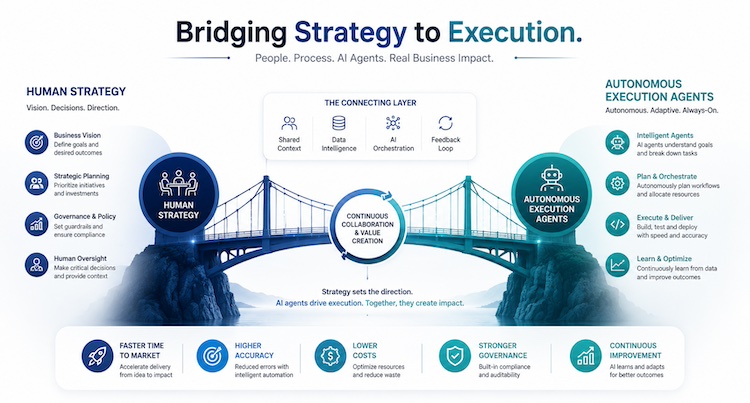
Leadership must learn to govern these autonomous digital workers. This involves establishing guardrails, defining operational boundaries, and creating human-in-the-loop validation frameworks. Understanding agentic systems allows executives to redesign business processes for maximum efficiency.
The Real Value of an Artificial Intelligence Course
How do you calculate the tangible return on investment for executive upskilling? The financial impact of a structured artificial intelligence course for leaders shows up across three main areas:
- Compressed Decision Cycles: Trained leaders validate tech proposals in hours rather than months.
- Risk Mitigation: Proper governance training prevents regulatory fines and reputational damage.
- Optimized Resource Allocation: Budgets are directed toward scalable infrastructure instead of vanity projects.
According to recent industry data, organizations with AI-literate leadership teams deploy machine learning initiatives 35% faster than their peers. Furthermore, these companies report a 22% higher profit margin on their technology investments.
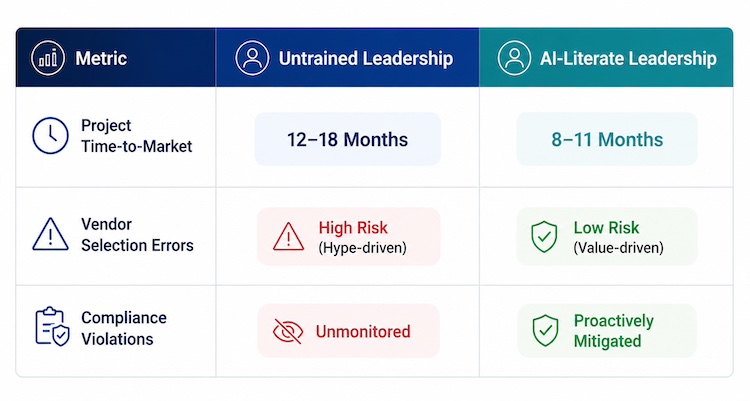
Investment in education directly reduces the failure rate of digital transformation projects. It transforms artificial intelligence from a vague line-item expense into a measurable driver of operational efficiency.
Implementing a Sustainable AI Learning Roadmap
How can your enterprise design an educational framework that keeps pace with rapid technological change? A sustainable roadmap avoids one-off workshops and focuses on continuous structured learning.
First, establish an internal AI Council led by trained executives. This group aligns learning objectives with specific quarterly business outcomes. Second, leverage targeted AI online courses to provide flexible, self-paced learning modules for busy global leaders.
Finally, incentivize experimental adoption. Leaders should actively use secure sandboxes to test automated workflows within their own departments. By modeling this behavior, the C-suite builds an agile corporate culture that views technological evolution as an opportunity rather than a threat.
Executive AI Competency Matrix
To help your organization evaluate its current leadership readiness, use this quick-reference competency check.
Core Executive Responsibilities
- Data Governance: Ensuring data pipelines are clean, compliant, and legally protected.
- Vendor Evaluation: Assessing third-party software based on accuracy, security, and integration capabilities.
- Talent Restructuring: Redefining job roles as automation shifts human workloads toward strategic oversight.
Key Technical Concepts Leaders Must Know
- Retrieval-Augmented Generation (RAG): Connecting LLMs to internal company databases for accurate, contextual outputs.
- Fine-Tuning: Training an existing model on proprietary data to perform specific, specialized tasks.
- Context Windows: The amount of data a model can process in a single interaction, affecting token costs and performance.
Conclusion: Lead the Automation Era
The choice facing modern enterprises is no longer whether to adopt intelligent automation, but how effectively to guide it. Executive literacy is the single greatest lever for unlocking corporate agility and sustaining long-term growth. When leaders understand the true mechanics of machine learning, they stop reacting to disruption and start driving it.
Optimize Your AI Strategy
Is your leadership team ready to navigate the complexities of enterprise automation? Contact our executive strategy team today to design a tailored governance, education, and implementation roadmap for your business.
Frequently Asked Questions
- Why is AI training critical for non-technical executives?
Non-technical executives make the budgetary and strategic decisions that govern technology implementation. Without foundational knowledge, they cannot accurately assess project risks, timelines, or financial returns. - What is the difference between Generative AI Training and Agentic AI Training?
Generative training focuses on systems that create content, summarize data, and assist human workers. Agentic training focuses on autonomous systems designed to plan, execute, and optimize complex workflows with minimal human intervention. - How do online AI courses fit into an executive's schedule?
Modern online courses offer modular, asynchronous learning pathways. This structure allows global leaders to build technical competencies without disrupting daily operational responsibilities. - What risks do companies face without an artificial intelligence training strategy?
Organizations risk severe data breaches, regulatory compliance fines, wasted technology spend, and loss of market share to competitors who automate workflows effectively. - How long does it take to see results from executive upskilling?
Companies typically see operational improvements within one quarter. This is reflected in faster vendor procurement, clearer technology roadmaps, and improved cross-departmental alignment.
Quick Summary
Strategic Imperative: Technology education bridges the communication gap between technical teams and business decision-makers. Shift to Agents: Leadership must prepare for autonomous workflows by mastering agentic governance frameworks. Measurable Value: Upskilled executive teams reduce project timelines and minimize expensive software procurement errors. Flexible Delivery: Using targeted online programs allows enterprises to scale education efficiently across global leadership teams.