This deep dive explores the shift from generative AI to an agentic workforce, focusing on AI leadership training UAE. By moving beyond basic literacy into "Context Engineering" and "Agentic Workflows," UAE leaders in sectors like energy, healthcare, and logistics can drive departmental efficiency while maintaining the "Human-in-the-loop" governance essential for regional trust and sovereign AI success.
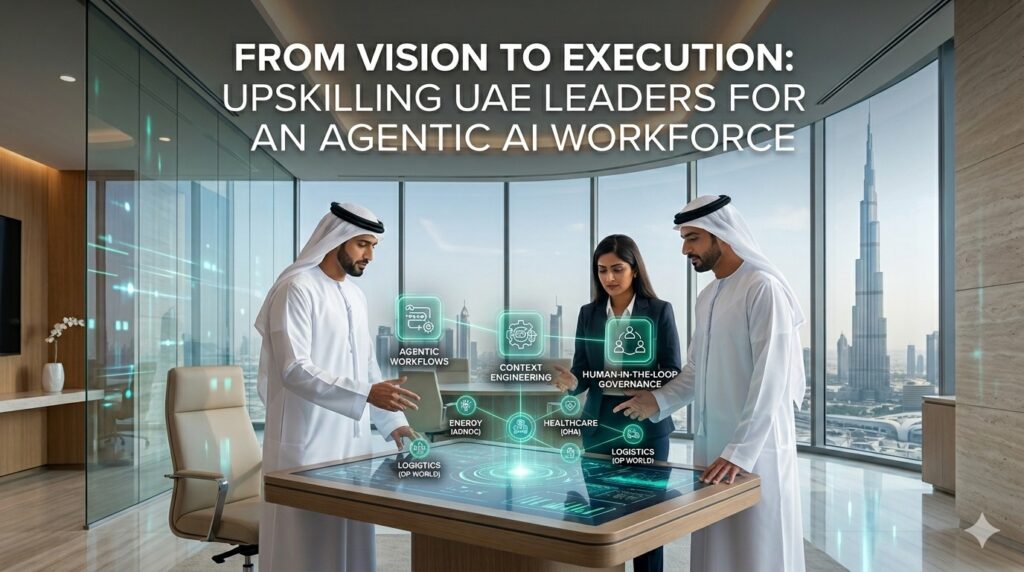
From Vision to Execution: Upskilling UAE Leaders for an Agentic AI Workforce
The UAE has officially moved past the "exploration" phase of Artificial Intelligence. In boardrooms from the sleek towers of DIFC to the industrial hubs of Ruwais, the conversation has shifted. It is no longer about what AI can do; it is about how AI can autonomously execute complex departmental goals.
As we navigate 2026, the competitive edge for local firms no longer rests on basic AI literacy. In an era where "GPT" is a household name, the true differentiator for the Emirati C-Suite is the mastery of Agentic Workflows and Context Engineering.
1. The Great Shift: From Passive Tools to Agentic Partners
For the past few years, the corporate world treated AI as a sophisticated typewriter or a faster search engine. We called this "Generative AI 1.0." However, the UAE’s National AI Strategy has always hinted at something deeper: integration.
What is an Agentic Workflow?
Unlike standard AI, which requires a human to "prompt" every single step, an Agentic Workflow utilizes AI "Agents" that can reason, plan, and use tools to achieve a high-level objective.
Imagine a Logistics Director at DP World. In the old model, they might ask an AI to "write a report on port congestion." In the Agentic model, the leader tasks an AI Agent to "optimize the offloading schedule for the next 48 hours." The Agent then:
- Accesses real-time weather data.
- Checks vessel arrival manifests.
- Communicates with automated crane systems.
- Drafts a schedule and sends it to human supervisors for a final "check-off."
Mastering Context Engineering
To lead this transition, UAE executives must move beyond simple prompt engineering and master Context Engineering. This is the strategic art of feeding AI the specific organizational DNA, regulatory constraints, and cultural nuances of the GCC. It’s about building a digital environment where the AI understands that an "urgent" request in the Energy sector has different safety parameters than one in Retail.
2. Strategic Comparisons: The UAE’s "Third Way"
To understand why AI leadership training in the UAE is unique, we must look at the global landscape. While the West and East engage in a binary race, the UAE has carved out a distinct strategic niche, often referred to by researchers as the "Third Way" (Cambridge, 2026).
| Feature | The US Narrative | The China Narrative | The EU Narrative | The UAE "Third Way" |
| Primary Driver | Market-led & VC-driven | State-led & Infrastructure | Regulation & Privacy-first | Vision-led & Agile Integration |
| AI Philosophy | Disruptive Innovation | National Parity/Control | Ethical Guardrails | Sovereign Capability (Falcon/Jais) |
| Leadership Focus | Efficiency/Profit | Scale/Monitoring | Compliance/Risk | Trust/Human-Centric Growth |
| Strategic Edge | Open-source dominance | Massive Data Pools | Standard-setting | High-Trust Sandboxes |
By adopting this "Third Way," UAE businesses benefit from "Sovereign AI"—using models like Falcon or Jais that are trained on local data, respecting local dialects, and adhering to regional values.
3. Trust: The Single Greatest Predictor of Success
In 2026, the Project Management Council (PMC) released a landmark study on Middle Eastern digital transformation. Their findings were startling: Trust is the single greatest predictor of AI implementation readiness in the UAE.
In many Western markets, the narrative is often one of "AI vs. Human." In the UAE, the culture favors a "Human-in-the-loop" (HITL) governance model.
Why Trust-Centric Frameworks Matter
For a leader in Abu Dhabi or Dubai, building an agentic workforce isn't about replacing the "human touch" that defines Arab business culture—it's about protecting it.
- Transparency: Employees need to know when they are interacting with an Agent.
- Accountability: AI agents must have "kill switches" and clear human escalations.
- Reliability: The AI must demonstrate "cultural intelligence," understanding the nuances of local business etiquette and legal frameworks.
4. Regional Case Studies: Agentic AI in Action
To move from theory to execution, let’s examine how specific UAE sectors are currently utilizing agentic workflows to dominate their respective markets.
Energy: ADNOC-Style Autonomous Operations
In the Energy sector, the goal is "Closed-Loop Automation." Instead of a human monitoring a dashboard and manually adjusting valves, Agentic AI systems monitor thousands of sensors across an oil field. When a pressure anomaly is detected, the Agent doesn't just send an alert; it analyzes the risk, suggests a mitigation strategy, and, upon human approval, executes the adjustment autonomously.
- Value Prop: Reduces downtime by 15% and minimizes human exposure to high-risk environments.
Healthcare: DHA Digital Workflows
The Dubai Health Authority (DHA) has been a pioneer in integrating digital twins and AI. Agentic workflows here take the form of "Clinical Co-pilots." These agents manage the administrative heavy lifting—matching patient records with insurance codes and DHA regulatory requirements—allowing doctors to focus 100% on the patient.
- Value Prop: 40% reduction in administrative burnout for medical staff.
Logistics: The "Negotiating" Supply Chain
In the logistics hubs of Jebel Ali, AI Agents act as "Digital Brokers." If a ship is delayed by a storm in the Indian Ocean, the Agentic system automatically communicates with warehouse managers and trucking fleets to reschedule arrivals, essentially "negotiating" the best possible logistical outcome without a human needing to send a hundred emails.
- Value Prop: Real-time resiliency in the face of global supply chain volatility.
5. Implementation: The 4-Step Roadmap for UAE Leaders
If you are a B2B leader looking to initiate AI leadership training in the UAE, your roadmap should follow this execution-heavy framework:
I. Audit for "Agent-Ready" Tasks
Not every task needs an Agent. Identify departmental silos where high-volume, multi-step processes exist—such as procurement, HR onboarding, or financial reporting.
II. Invest in Context Engineering
Ensure your data isn't just "clean," but "contextual." This means mapping your internal policies, local UAE laws, and brand voice into a knowledge base that your AI Agents can tap into.
III. Deploy "Human-in-the-Loop" Governance
Establish a steering committee. Every autonomous action taken by an AI Agent should be logged and auditable. In the UAE, leadership is synonymous with responsibility; AI does not change that.
IV. Upskill for "Orchestration"
The role of the manager is changing. They are no longer "taskmasters" but "orchestrators." Training must focus on how to manage a hybrid team of five humans and fifty AI agents.
Conclusion: The New Era of Emirati Leadership
The transition to an Agentic AI workforce is not a technical challenge; it is a leadership opportunity. By moving beyond basic literacy to master Agentic Workflows and Context Engineering, UAE leaders are doing more than just improving efficiency—they are future-proofing the nation’s economy.
The vision of the UAE has always been to lead from the front. In the world of AI, that means moving from "asking" the machine to "leading" the machine.
Frequently Asked Questions
- What is the difference between Generative AI and Agentic AI?
Generative AI focuses on creating content (text, images) based on a prompt. Agentic AI focuses on action. An AI Agent can use tools, browse the web, and execute a multi-step plan to achieve a goal with minimal human intervention. - Why is "Context Engineering" more important than Prompt Engineering?
Prompting is a one-off interaction. Context Engineering involves building the entire knowledge environment—including UAE laws, company history, and cultural nuances—that the AI uses to ensure its autonomous actions are accurate and safe. - Is AI going to replace leadership roles in the UAE?
No. Regional research (PMC, 2026) suggests that the UAE model favors "Human-in-the-loop" governance. AI will handle the "execution" of tasks, but the "vision," "ethics," and "final accountability" remain exclusively human leadership traits. - How does the UAE’s "Third Way" benefit my local business?
It allows your business to stay agile. You aren't locked into the rigid regulations of the EU or the purely profit-driven motives of US tech giants. You benefit from sovereign models like Falcon that understand the local market better than global alternatives. - What is the first step to upskilling my department?
Start with an "Agentic Audit." Identify one multi-step process—like vendor onboarding or monthly financial reconciliation—and map out how an AI Agent could handle the steps while a human provides the final oversight.
Quick Summary
The blog explores the shift from basic Generative AI to "Agentic AI" in the UAE business landscape. It emphasizes that 2026 leadership requires mastery of Agentic Workflows (autonomous task execution) and Context Engineering (tailoring AI to local organizational and cultural needs). Key Takeaways: Trust is Paramount: According to PMC (2026), trust is the #1 driver of AI adoption in the UAE. The Third Way: The UAE utilizes a unique strategic position between US, China, and EU models, focusing on "Sovereign AI" and agile regulation. Sector Impact: Practical applications are already seen in ADNOC (Energy), DHA (Healthcare), and DP World (Logistics). Governance: Successful implementation requires a "Human-in-the-loop" approach to maintain accountability and cultural integrity.