
What Does an AI Strategy Consultant Do? The Executive’s Guide to Context Engineering
An AI strategy consultant helps executives turn unreliable AI pilots into scalable, high-ROI systems through context engineering — the disciplined art of delivering the right information to AI models at the right time.measurable ROI.

Introduction
Are your AI initiatives stuck in pilot mode?
Many executives invest heavily in generative AI yet see little return. According to MIT research, 95% of generative AI pilots deliver zero measurable impact on profit and loss. Teams chase flashy demos while core systems fail to scale.
This is where an AI strategy consultant steps in. These experts move beyond basic prompting. They focus on context engineering—the disciplined practice of feeding the right information to AI models at the right time. As a result, AI becomes reliable, secure, and aligned with business goals.
In this guide, you will discover exactly how context engineering works, why it matters more than ever, and how partnering with an AI consultant helps you capture real value.
What Is Context Engineering?
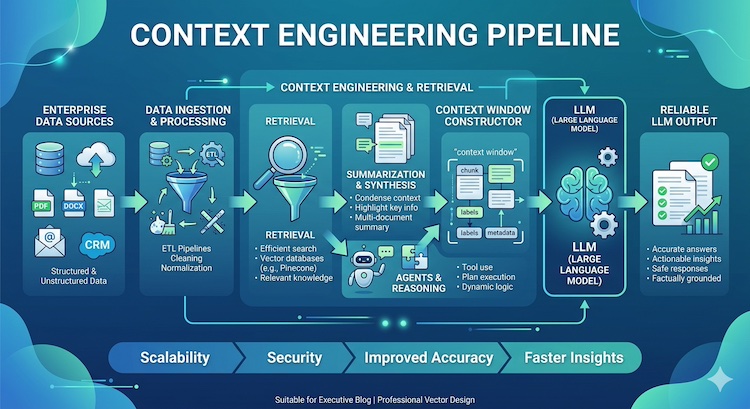
Context engineering is the systematic design of everything an AI model “sees” before it responds. Unlike prompt engineering, which crafts instructions for a single task, context engineering builds dynamic systems. These systems retrieve, structure, and deliver the precise data, rules, and history the model needs.
Think of the context window as limited RAM. Prompt engineering writes the program. Context engineering loads only the relevant files—nothing more, nothing less.
For example, a customer support agent no longer receives every policy document. Instead, the system pulls the exact refund rule for the customer’s region, recent order history, and prior chat summary. The model then answers accurately without hallucinating.
Key elements of effective context engineering include:
- Retrieval systems (such as RAG) that fetch fresh, relevant data on demand.
- Structuring tools that compress or summarize long histories.
- Memory layers that persist knowledge across sessions without bloating the window.
- Guardrails that enforce compliance and brand voice.
As a result, AI agents handle complex, multi-step tasks reliably. Executives gain predictable outcomes instead of random surprises.
The AI Strategy Consultant’s Role in Context Engineering Success
An AI strategy consultant translates business objectives into technical context systems. They do not simply recommend tools. They architect the entire information environment that makes AI work at scale.
First, they assess your current data landscape and identify gaps. Next, they design retrieval pipelines that connect CRMs, knowledge bases, and real-time feeds. Then, they implement governance layers so outputs stay compliant and trustworthy.
Moreover, these consultants align context engineering with broader AI governance. They ensure every context decision supports risk management, data privacy, and ethical standards.
Here is what a typical engagement looks like:
- Audit existing AI pilots and map failure points to missing context.
- Build custom context frameworks tailored to your industry and workflows.
- Train internal teams on maintenance so systems evolve without constant external help.
- Measure success through clear KPIs such as accuracy rate, cost per inference, and business impact.
Therefore, executives avoid the common trap of technology-first experiments. Instead, they pursue strategy-first implementations that deliver sustained ROI.
Context Engineering vs. Prompt Engineering: Why the Shift Matters
Prompt engineering remains useful for quick tasks. However, it breaks down in production environments. A beautifully written prompt still fails if the model lacks the right background facts.
Context engineering solves this at the system level. It treats information flow as an engineering discipline rather than an art.
Quick comparison:
| Aspect | Prompt Engineering | Context Engineering |
|---|---|---|
| Focus | Single instruction wording | Entire information environment |
| Scope | One query | Multi-step agent workflows |
| Maintenance | Manual tweaks per use case | Automated, dynamic pipelines |
| Enterprise fit | Good for prototypes | Required for reliable scaling |
For instance, an incident triage agent in IT operations needs live telemetry, recent change logs, and escalation policies. A static prompt cannot supply these. Context engineering pulls them automatically. As a result, resolution times drop and errors decrease. To know more read this blog.
Executives who master this distinction move from experimental AI to embedded intelligence.

Proven Benefits and Data-Backed Impact
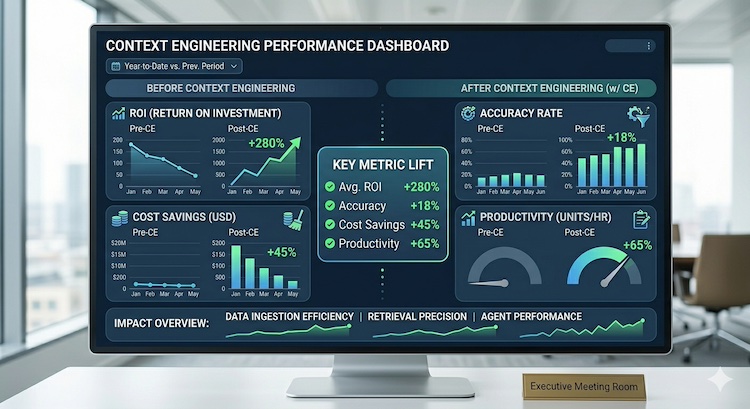
Context engineering directly addresses the 95% failure rate of generative AI pilots. Organizations that invest here see measurable gains.
Recent Deloitte data shows worker access to AI rose 50% in 2025, yet only a minority report strong productivity or revenue impact. Those who apply systematic context engineering belong to that successful minority. They achieve higher accuracy, lower hallucination rates, and faster time-to-value.
Tangible executive benefits include:
- Faster decision-making through context-rich insights.
- Lower operational costs via efficient token usage and fewer failed inferences.
- Stronger compliance with built-in policy and audit trails.
- Scalable AI agents that handle complex processes end-to-end.
One manufacturing client, for example, reduced supply-chain query resolution time by 70% after implementing dynamic context retrieval. Another financial services firm cut compliance review effort by half.
These outcomes stem from disciplined context design—not luck or bigger models.
Steps to Build a Robust Context Engineering Strategy with Your AI Consultant
Ready to act? Follow this practical roadmap.
- Assess current state. Map data sources, identify silos, and quantify pilot failure reasons.
- Define success metrics. Tie context decisions to business KPIs such as revenue lift or cost savings.
- Design the context layer. Choose retrieval methods, summarization rules, and memory architecture.
- Pilot in one high-impact workflow. Start small, measure rigorously, then expand.
- Establish governance. Set policies for context freshness, access controls, and versioning.
- Monitor and iterate. Use observability tools to track context quality over time.
An experienced AI strategy consultant accelerates every step. They bring proven frameworks and avoid common pitfalls such as context overflow or stale data.
Therefore, your team reaches production faster and with greater confidence.
Conclusion
Context engineering represents the missing layer between AI experiments and enterprise value. It turns promising technology into predictable business advantage.
Executives who embrace it—guided by a skilled AI strategy consultant—position their organizations ahead of the competition. They avoid the 95% failure trap and capture the real productivity and revenue gains AI promises.
The shift requires strategic thinking, not just technical tweaks. Yet the payoff is substantial: more intelligent operations, confident decision-making, and sustainable competitive edge.
Ready to Engineer Better Outcomes?
If your AI efforts need clearer direction and stronger results, consider a focused strategy review. Explore how tailored context engineering can align with your specific goals and governance needs. The right advisory support turns AI from a cost center into a growth engine.
Reach out to discuss your current challenges. Strategic clarity today prevents costly rework tomorrow.
Frequently Asked Questions
- What exactly is context engineering?
Context engineering designs the dynamic information an AI model receives before generating each response. It ensures the model has the right facts, rules, and history without exceeding context limits. - How does context engineering differ from prompt engineering?
Prompt engineering focuses on wording instructions. Context engineering builds the entire supporting information system. The two work together, but context engineering drives reliability at scale. - Why do so many AI projects fail without it?
Most failures trace to missing or irrelevant information inside the model’s context window. Even perfect prompts cannot compensate for poor context. - How can an AI strategy consultant help my organization?
They assess your data environment, design custom context systems, align them with business goals, and implement governance so AI delivers consistent ROI. - What industries benefit most from context engineering?
Finance, healthcare, manufacturing, customer service, and IT operations see the fastest gains. Any domain with complex rules, live data, or multi-step processes benefits. - Is context engineering expensive to implement?
Initial setup requires investment, yet it quickly pays for itself through higher accuracy, lower token costs, and reduced rework. Most clients see payback within months.
Quick Summary
Key Takeaways Context engineering curates the optimal information for every AI interaction—far beyond simple prompts. 95% of generative AI pilots fail due to inadequate context; systematic engineering reverses this. An AI strategy consultant builds the frameworks, governance, and pipelines that make AI reliable and scalable. Benefits include faster decisions, lower costs, stronger compliance, and measurable business impact. Start with one workflow, measure rigorously, and expand with expert guidance.