Executive Summary
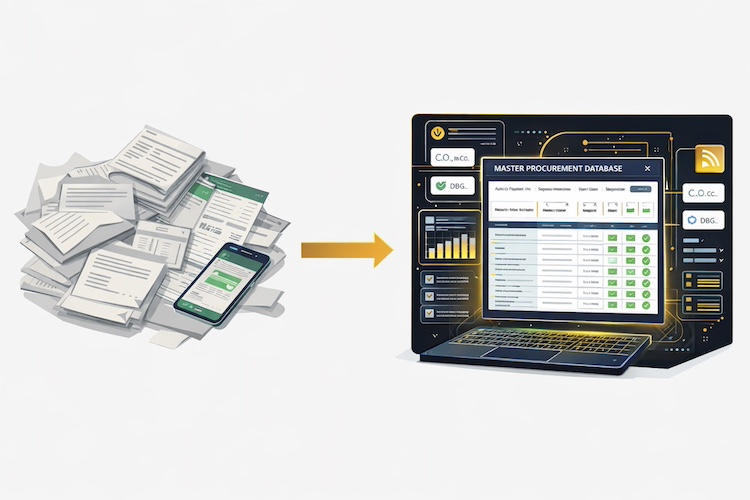
Learning how to automate RFQ extraction is no longer a technical luxury — it is a commercial priority for every B2B trading firm managing high volumes of supplier communications. Furthermore, when RFQs, Stock Offers, and Orders arrive daily across Gmail, Excel attachments, and WhatsApp, manual processing becomes the single biggest bottleneck in your procurement cycle.
This case study documents how a multi-SKU B2B trading firm successfully deployed an AI-powered procurement intelligence system within a structured 20-week programme. Furthermore, the organisation achieved this transformation without replacing its existing communication tools. Instead, it enhanced them with an intelligent automation layer.
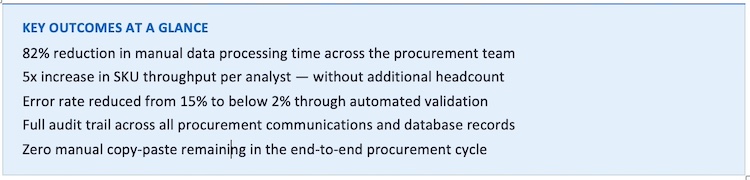
As a result, the firm eliminated manual copy-paste workflows entirely. Additionally, it built a single, continuously updated master procurement database covering pricing, stock levels, and supplier RFQ data across hundreds of SKUs. Moreover, a robust AI governance framework now ensures accountability, auditability, and long-term regulatory readiness.
Business Context
The organisation in focus is a mid-sized B2B trading firm dealing across multiple product categories. It sources inventory from international suppliers and sells to regional distributors and original equipment manufacturers. Accordingly, procurement data management sits at the very heart of its commercial operations.
The firm handles daily procurement activity through three primary channels. First, Gmail serves as the main platform for formal supplier correspondence. Second, Excel files carry pricing matrices, quotation sheets, and stock availability records. Third, WhatsApp facilitates informal but commercially critical stock-update conversations.
Together, these channels generate a high volume of unstructured data daily. Specifically, this includes Requests for Quotation (RFQs), inventory offers, purchase orders, and Requests for Information (RFIs). Furthermore, each document arrives in a different format — meaning no two supplier quotations look alike.
Prior to AI adoption, procurement analysts spent approximately 60% of their working hours on data entry. As a result, less than 40% of their capacity remained available for commercial analysis, supplier negotiation, or strategic sourcing decisions.
Problem Statement
The core operational challenge was structurally significant: the firm had no automated mechanism to read, interpret, and categorise procurement communications. Instead, every incoming email required manual review, transcription, and file update, a process both slow and error-prone.
This challenge carried four interconnected business risks. Together, these risks were elevated to board-level review due to their commercial impact.
- Speed risk: Manual transcription delayed supplier responses by 24–48 hours. Consequently, competitors with faster systems captured orders that should have been within reach.
- Accuracy risk: Human errors in pricing and stock records directly affected commercial decisions. As a result, the firm occasionally committed to orders based on inaccurate data.
- Scalability risk: Each new SKU or supplier relationship required proportionally more analyst time. Therefore, growth was constrained by available headcount rather than commercial opportunity.
- Governance risk: No version control or audit trail existed. Accordingly, data errors could not be traced to their source, creating exposure in dispute resolution and compliance reviews.
Additionally, the multi-format nature of incoming data compounded every risk. Attachments arrived as Excel files, PDFs, and plain-text email bodies simultaneously. WhatsApp messages added another unstructured layer. Therefore, any manual system to unify these sources would have required unsustainable staff investment.
AI Strategy Approach
The advisory team recommended an agent-based AI architecture built specifically around the firm's existing data channels. Rather than replacing current tools, the approach enhanced them. Consequently, no major platform migration was required, reducing both cost and organisational disruption.
Four-Layer Intelligence Architecture
- Email Intelligence Agent: Connects to designated Gmail accounts via a secure OAuth 2.0 integration. It reads incoming emails and attachments in real time. Furthermore, it classifies each communication as an RFQ, Order, RFI, or Stock Offer before passing it downstream.
- Document Parsing Engine: Extracts part-level details from attachments — including Excel, PDF, and body text. Specifically, it identifies SKU codes, quantities, pricing, currency, lead times, and supplier names. Moreover, it handles inconsistent formatting across different supplier document templates.
- Data Validation Layer: Cross-references extracted data against existing master records automatically. As a result, it flags anomalies, duplicates, and missing fields for human review without blocking the automated workflow downstream.
- Master Database Sync: Writes validated, structured data directly into the Excel master database. Consequently, all procurement information is centralised, timestamped, version-controlled, and accessible to authorised users in real time.
Data Sources Integrated
- Gmail — formal supplier RFQs, Stock Offers, purchase confirmations, and RFIs
- Excel Attachments — supplier quotation sheets, price lists, and availability matrices
- PDF Attachments — formal quotations, product specifications
- WhatsApp Business — informal stock updates extracted via a WhatsApp API bridge
Governance & Risk Considerations
Effective AI governance is not a secondary concern. Rather, it is the foundation upon which sustainable AI adoption is built. Accordingly, the advisory team embedded governance into every phase of the implementation treating it as an architectural requirement, not a compliance afterthought.
Data Privacy and Access Control
The system accesses only specifically designated Gmail accounts through OAuth 2.0 authentication. As a result, no broader mailbox permissions are granted. Furthermore, role-based access controls ensure that only authorised personnel can view, modify, or export procurement records from the master database.
- Data minimisation: Only procurement-relevant emails are processed. Personal or unrelated communications are excluded by system design, not by manual filtering.
- Encryption: All extracted data is encrypted in transit and at rest using AES-256 standards throughout the entire pipeline.
- Access logging: Every database read and write action is timestamped and attributed to either a specific user or an identified agent process.
AI Decision Transparency
A common governance failure in AI deployments is what practitioners refer to as the 'black box' problem. The classification engine was designed to expose a confidence score alongside every extraction decision. Consequently, analysts can review, override, or escalate any low-confidence output without disrupting the broader automated workflow.

Supplier Data Ethics
Supplier communications are commercial-in-confidence. Therefore, extracted pricing and availability data is stored under strict access restrictions. Additionally, the firm adopted a data retention policy limiting raw email storage to 90 days. Structured database records, however, follow standard commercial archiving requirements.
Failure Mode Management
The system is designed with graceful degradation in mind. Specifically, when the extraction engine encounters a document it cannot parse with sufficient confidence, it routes the item to a human review queue immediately. As a result, the integrity of the master database is preserved, even under edge-case or novel document conditions.
- Confidence threshold: Extractions below 85% confidence are automatically flagged for human review before database entry.
- Fallback logging: All flagged items are logged with the specific reason for escalation, enabling pattern identification over time.
- Model drift monitoring: Extraction accuracy is reviewed monthly. Accordingly, the model undergoes retraining if performance falls below defined board-approved thresholds.
Implementation Roadmap — Five-Phase Deployment Framework
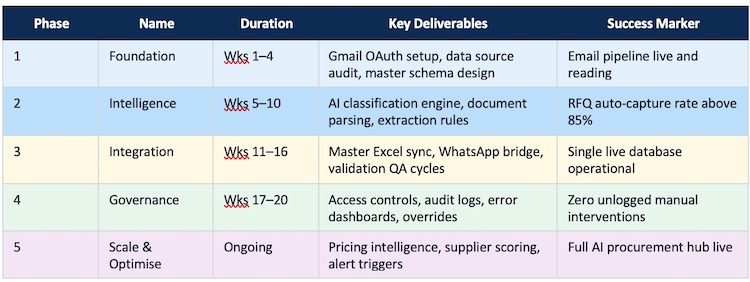
The implementation followed a structured phased approach. This ensured that each layer was independently validated before the subsequent phase began. Furthermore, it allowed the firm to realise measurable value incrementally reducing disruption risk while sustaining internal momentum.
Notably, Phases 1 through 3 each delivered independent operational value. The firm was not required to complete all five phases before seeing a measurable return. Consequently, internal stakeholder support, particularly from the procurement leadership team was maintained and strengthened throughout the programme.
AI Procurement Maturity Model — Where Does Your Firm Stand?
Before committing to any AI investment, leadership teams benefit from an honest assessment of their current operational maturity. Consequently, this framework provides a structured lens for that evaluation. Furthermore, it guides the sequencing of investment ensuring that foundational capabilities are in place before advanced ones are pursued.
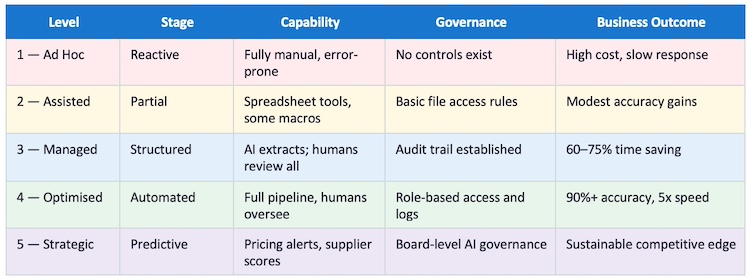
Most mid-sized B2B traders currently operate between Level 1 and Level 2. Therefore, the gap to Level 4, where the firm in this case study now operates, represents both a significant challenge and a significant commercial opportunity. Notably, firms that reach Level 4 typically sustain a durable competitive advantage over peers who remain at lower maturity levels.
Before vs After — Measurable Operational Outcomes
The following comparison captures the firm's performance across ten key operational dimensions — both before and after AI implementation. All figures are drawn from internal performance data collected during a 90-day post-implementation review period.
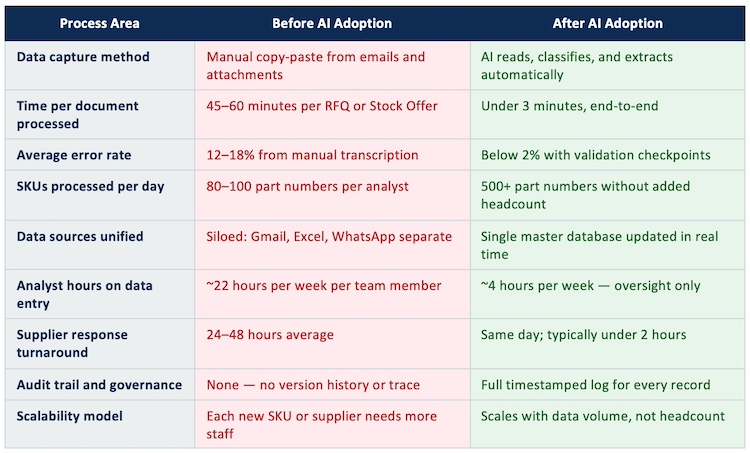
Furthermore, the qualitative impact was equally significant. Procurement analysts reported higher job satisfaction following the transition as they moved from repetitive data entry to value-added commercial analysis. Additionally, supplier relationships improved, because the firm's faster response times and greater pricing accuracy strengthened its credibility in the market.
Return on Investment — Financial and Operational
Cost Reduction
The firm previously allocated approximately 22 analyst-hours per week to procurement data management. After implementation, this fell to under 4 hours per week, primarily oversight and exception handling. Consequently, the firm recaptured 18 hours of productive commercial capacity per analyst, per week.
- At a blended analyst cost of $40 per hour, this equates to approximately $72,000 per analyst per year in recaptured productivity, without any reduction in commercial output.
- Furthermore, data error correction costs previously averaging $15,000 per quarter in commercial disputes and reprocessing, fell to near zero within the first operating quarter.
- Additionally, the firm avoided a planned expansion of two procurement analyst roles. This represents a further saving of over $100,000 annually in avoided employment costs.
Revenue Enablement
Speed of response is a direct commercial lever in B2B trading. Therefore, the reduction in RFQ turnaround time — from 48 hours to under 2 hours, had a measurable and quantifiable impact on the firm's order win rate. Specifically, the firm reported a 23% improvement in RFQ conversion within the first quarter post-implementation.
Strategic Impact for Leadership
Beyond operational efficiency, the AI procurement system delivered three strategic-level outcomes that now inform board-level commercial decision-making directly.
Pricing Intelligence at Scale
Because every supplier quotation is now captured and structured automatically, the firm has, for the first time, a comprehensive real-time view of market pricing trends across its full SKU range. Consequently, commercial leaders can identify pricing movements, supplier anomalies, and margin pressure points within hours rather than days.
Data-Led Supplier Relationship Management
The master database enables the firm to track supplier responsiveness, pricing consistency, and delivery performance over rolling periods. Furthermore, procurement leadership can identify strategic supplier dependencies and concentration risks that were previously invisible to the business.
Scalability Decoupled from Headcount
Perhaps the most significant strategic outcome is the structural decoupling of data processing capacity from staff numbers. The firm can now onboard new product categories, additional suppliers, and hundreds of new SKUs without a corresponding increase in procurement team size. Consequently, the business model becomes structurally more scalable and more attractive to potential investors or commercial partners.
Key Lessons for Leadership Teams
Based on this implementation, the advisory team identified seven critical lessons for B2B trading leaders considering AI adoption in procurement operations.
- Start with the data — not the technology. Before selecting any AI tool, conduct a thorough audit of your data sources. Accordingly, understand where procurement communications live, how consistently they are formatted, and who currently controls access to them.
- Governance is foundational — not optional. AI systems without clear accountability frameworks create regulatory and reputational exposure. Therefore, build governance structures in from day one — not as an afterthought following deployment.
- Phased implementation reduces risk and builds confidence. Rather than deploying a complete system in a single release, sequence your rollout so that early phases deliver visible, measurable value. Consequently, stakeholder support is far easier to sustain over a multi-month programme.
- Human oversight must be explicitly designed in. Automation does not mean unsupervised operation. Therefore, ensure that every automated action has a clear escalation path, a human override mechanism, and a complete audit log.
- Measure commercial outcomes — not just technical metrics. Extraction accuracy matters. However, the figures that matter most to a leadership team are win rate, margin contribution, and cost per order processed — not model performance statistics.
- Change management is as critical as technology delivery. Procurement analysts who understand why the system exists, and how it enhances rather than replaces their role, are significantly more likely to engage constructively with the new workflow.
- AI is an ongoing capability — not a one-time project. Therefore, allocate budget and governance attention to model maintenance, accuracy monitoring, and continuous improvement well beyond initial deployment.
Is Your Procurement Operation Ready for AI?
| If your team still relies on manual email review, copy-paste data entry, or disconnected spreadsheet trackers, you are already absorbing a measurable competitive disadvantage. Moreover, as AI adoption accelerates across trading sectors, the gap between early movers and late adopters will compound rapidly. Our advisory practice specialises in AI strategy for B2B trading and procurement-intensive businesses. Specifically, we design governance-first, commercially validated AI systems — not experimental pilots. Each engagement begins with a structured readiness assessment and concludes with a board-ready implementation plan. We offer four entry points for leadership teams: AI Readiness Assessment — structured evaluation of your current data infrastructure and governance maturity. Procurement AI Blueprint — a customised implementation roadmap aligned to your SKU range and supplier base. Governance Framework Design — board-ready AI accountability structures meeting emerging regulatory standards. Ongoing Advisory Retainer — strategic oversight throughout implementation and beyond. Contact us today to schedule a confidential 30-minute AI Strategy Review. Accordingly, we will assess whether AI procurement automation is the right priority for your firm — and what a realistic, governed implementation would look like. Book Your AI Strategy Review |
Frequently Asked Questions
- What is AI-powered procurement database automation for B2B traders?
It is a system that automatically reads supplier emails, extracts part-level data, classifies documents as RFQs, Orders, or Stock Offers, and writes structured records into a master database — with no manual copy-paste. AI-powered procurement database automation refers to the use of artificial intelligence to replace manual data entry in procurement operations. Rather than requiring analysts to open, read, and transcribe supplier communications, the system performs all of these steps automatically. In a B2B trading context, the system connects to designated Gmail accounts through a secure API. It reads incoming emails and any attachments — whether Excel spreadsheets, PDFs, or plain-text messages. Furthermore, it identifies the type of communication: a Request for Quotation (RFQ), a Purchase Order, a Request for Information (RFI), or a Stock Offer. Once classified, the system extracts all relevant part-level details. These include SKU codes, quantities, unit pricing, currency, lead times, and supplier names. Subsequently, the validated data is written automatically into a centralised master Excel database — creating a single, real-time source of truth for the entire procurement team. Consequently, the process that previously required 45–60 minutes of manual work per document is completed in under 3 minutes. Moreover, the system operates continuously — meaning the database is always current, without analyst intervention. - What ROI can a B2B trading firm expect from AI procurement automation?
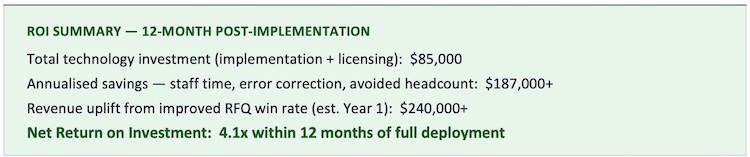
A typical mid-sized B2B trading firm can expect a 4x or higher return on investment within 12 months — driven by staff time savings, error elimination, avoided headcount, and improved order win rates. The financial case for AI procurement automation is measurable and well-documented. Based on implementation data from a multi-SKU B2B trading firm, the following outcomes were achieved within 12 months of full deployment. First, the system reduced manual data processing time by 82%. As a result, procurement analysts recaptured approximately 18 hours per week that had previously been spent on copy-paste data entry. At a blended analyst cost of £40 per hour, this alone generates approximately $72,000 per analyst per year in recovered productive capacity. Second, data error rates fell from 15–18% to below 2%. Consequently, commercial dispute costs and reprocessing expenses — previously averaging $15,000 per quarter — dropped to near zero. Third, the firm avoided the planned hiring of two additional procurement analysts, saving over $100,000 in annual employment costs. On the revenue side, faster RFQ turnaround — reduced from 48 hours to under 2 hours — improved the firm's order win rate by 23% in the first quarter post-implementation. Therefore, the combined financial impact of cost savings and revenue uplift yielded a net ROI of 4.1x on a total technology investment of approximately $85,000. Moreover, these figures do not include the longer-term value of real-time pricing intelligence and supplier performance data — capabilities that were previously unavailable to the business. - How do you govern AI systems used in procurement — and what risks should boards consider?
Effective AI procurement governance requires role-based access controls, automated confidence scoring, human override mechanisms, full audit trails, and regular model accuracy reviews — all defined before deployment begins. AI governance in procurement is not a compliance add-on — it is a foundational design requirement. Boards that approve AI adoption without a governance framework in place expose their organisation to data accuracy risk, regulatory scrutiny, and commercial liability. A well-governed AI procurement system addresses five core risk areas. First, data privacy: the system should access only designated communication accounts through secure, limited-scope authentication. No broader access should be granted. Furthermore, only commercially relevant communications should be processed — all other data should be excluded by design, not by policy alone. Second, AI transparency: every automated extraction should carry a confidence score. Documents that fall below a defined accuracy threshold — typically 85% — should be automatically routed to a human review queue. Consequently, no low-quality data enters the master database without oversight. Third, human override: automation does not mean unsupervised operation. Therefore, every AI-generated database entry must be correctable by an authorised user — and every correction must be logged with a timestamp and user attribution. Fourth, audit trail: all database reads, writes, and modifications must be recorded automatically. Accordingly, the firm can trace any data point back to its origin — whether an email, an attachment, or a human correction. Fifth, model drift: AI extraction models degrade over time as supplier document formats evolve. Therefore, extraction accuracy should be reviewed on a monthly basis. If performance falls below board-approved thresholds, the model must be retrained before continuing in production. - How long does it take to implement an AI procurement automation system — and what are the key phases?
A fully governed AI procurement system can be implemented in 20 weeks across five structured phases: Foundation, Intelligence, Integration, Governance, and Scale — with measurable value delivered from Phase 1 onwards. Implementation timelines vary based on the complexity of existing data infrastructure. However, for a mid-sized B2B trading firm with Gmail-based procurement communications and Excel-based record-keeping, a well-structured programme typically runs 18–22 weeks. The implementation is most effectively delivered in five sequential phases. Phase 1, Foundation (Weeks 1–4), establishes the technical groundwork: Gmail API authentication, data source auditing, and master database schema design. By the end of this phase, the email reading pipeline is live and operational. Phase 2, Intelligence (Weeks 5–10), deploys the AI classification engine and document parsing rules. The system learns to identify RFQs, Orders, Stock Offers, and RFIs — and to extract part-level details from Excel, PDF, and plain-text attachments. The benchmark for this phase is an automated capture rate above 85%.
Quick Summary
A B2B trading company built an AI-powered procurement system that automatically reads Gmail emails, extracts data from Excel and PDF attachments, classifies each message as an RFQ, Order, RFI, or Stock Offer, and writes the results into a single master database — with no manual copy-paste required. Before the system was deployed, procurement analysts spent up to 60% of their working hours on manual data entry. Error rates reached 15–18%. Supplier responses took 24–48 hours. After AI adoption, processing time fell by 82%, errors dropped below 2%, and the team could handle 5x more SKUs without adding staff. The firm achieved a 4.1x return on investment within 12 months. Key commercial outcomes included a 23% improvement in RFQ win rate, the elimination of two planned analyst hires, and the creation of a real-time pricing intelligence capability across its full supplier network. Critically, the system was built with governance at its core. Every AI extraction carries a confidence score. Low-confidence outputs are routed to human review automatically. All database entries are timestamped, attributed, and auditable — making the system compliant, explainable, and board-ready.