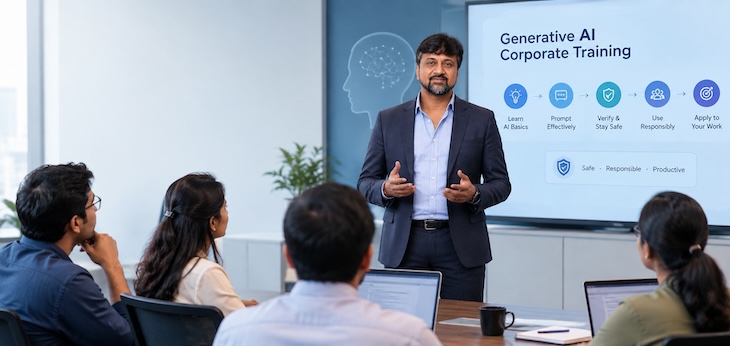
Generative AI Corporate Training should teach employees much more than how to write prompts or use ChatGPT. Employees need to understand what generative AI can do, where it can fail, how to work with it effectively, and how to use it within organizational policies.
That distinction matters because AI adoption is moving from experimentation into everyday business work. Microsoft’s 2025 Work Trend Index found that 51% of managers surveyed expect AI training or upskilling to become a key responsibility for their teams within five years.
At the same time, the World Economic Forum’s Future of Jobs Report 2025 identifies skills gaps as a major barrier to business transformation. The report says that nearly 40% of job skills are expected to change by 2030, while AI, big data, and cybersecurity skills are among those expected to grow rapidly in demand.
Therefore, the question for business leaders is no longer simply whether employees should learn generative AI. The more useful question is: What should employees learn, and how should that learning connect to their actual work?
A strong program combines AI literacy, practical prompting, critical evaluation, data protection, responsible use, and role-specific application.
What Should Employees Learn in Generative AI Corporate Training?
Employees should develop six core capabilities:
- AI literacy: Understanding what generative AI is and where it can fail.
- Effective prompting: Giving AI clear objectives, context, constraints, and examples.
- Critical evaluation: Checking AI outputs for accuracy, relevance, bias, and unsupported claims.
- Data protection: Knowing what information can and cannot be entered into AI systems.
- Responsible AI use: Maintaining human accountability and following organizational policies.
- Role-based application: Applying AI to relevant business workflows.
These capabilities work together.
For example, an employee may know how to generate a polished business report with AI. However, that skill has limited value if the employee cannot identify fabricated information or accidentally exposes confidential company data.
In practical terms, effective GenAI corporate training should teach employees how to work with AI, not simply how to operate an AI application.
Why Does GenAI Corporate Training Matter?
Generative AI can support research, writing, analysis, communication, coding, customer service, knowledge management, and many other activities. However, access to an AI tool does not automatically create productive adoption.
Microsoft’s 2025 research shows a growing gap between leaders and employees in familiarity with AI agents. Globally, 67% of leaders surveyed said they were familiar or extremely familiar with AI agents, compared with 40% of employees.
That gap has implications for workforce development.
Employees need enough knowledge to understand where AI fits into their work. Managers also need to know how to guide responsible adoption, identify appropriate use cases, and measure outcomes.
Furthermore, AI training needs to keep pace with changing workplace expectations. Microsoft’s research reports that leaders expect employees to take on responsibilities such as training and managing AI agents within five years.
Consequently, corporate AI training is becoming less about isolated software skills and more about building organizational AI capability.
What Should Employees Learn First?
1. AI Fundamentals and Limitations
Employees do not need to become AI engineers. Nevertheless, they need enough AI literacy to make sensible decisions about AI.
Training should explain:
- What generative AI does
- How large language models work at a practical level
- Why AI can generate incorrect information
- What hallucinations are
- Why context affects output quality
- Why different AI systems can produce different responses
- Where human judgment remains necessary
For example, an employee using AI to summarize a company policy should understand that the summary is an AI-generated interpretation. Important requirements should still be checked against the original policy.
This foundation prevents two opposite mistakes. Employees should not treat AI as an unquestionable authority, but they also should not assume that AI is useless simply because it can make mistakes.
2. Prompting and Task Design
Prompting is an important skill, but prompt engineering training should not become a collection of clever prompts that employees memorize.
Instead, employees should learn how to communicate effectively with AI.
A useful prompt generally provides:
- A clear objective
- Relevant context
- The intended audience
- Desired output format
- Constraints
- Examples where appropriate
- Quality criteria
For instance, instead of asking an AI tool to “write a customer email,” an employee can provide the customer situation, desired tone, business objective, important facts, length, and required action.
Employees should also learn to iterate. The first response is rarely the final response.
A practical workflow is:
Define → Prompt → Review → Refine → Verify → Apply
This approach is more transferable than teaching hundreds of tool-specific prompts.
3. Verification and Critical Thinking
This is one of the most important areas in Generative AI Corporate Training.
AI can produce fluent, convincing text. However, fluency does not guarantee accuracy.
Employees therefore need practical methods for checking outputs, including:
- Fact checking
- Source verification
- Numerical validation
- Identifying unsupported claims
- Checking missing context
- Reviewing potentially biased outputs
- Comparing AI recommendations with authoritative sources
Consider an employee using AI to prepare a market analysis. The employee should not automatically accept statistics or citations generated by a model.
Instead, important claims should be verified against appropriate primary or authoritative sources.
This principle becomes even more important as AI moves into higher-value business processes.
Should Employees Receive ChatGPT Training?
ChatGPT training for employees can be valuable, but it should be part of a broader AI capability program.
ChatGPT is one example of a generative AI interface. Employees can learn useful skills through hands-on exercises involving research, drafting, summarization, analysis, brainstorming, document transformation, and structured problem solving.
However, training should not become dependent on one product interface.
The more durable skills are:
- Defining the task
- Providing context
- Asking precise questions
- Iterating on responses
- Evaluating output quality
- Protecting sensitive information
- Verifying important claims
- Applying human judgment
For example, an employee might use ChatGPT to convert meeting notes into an action list. The employee should still review the output for missing actions, incorrect names, deadlines, and commitments.
Therefore, the objective of ChatGPT training for employees should be transferable AI fluency rather than simple tool familiarity.
What Should a Corporate GenAI Workshop Include?
A corporate GenAI workshop should be practical, interactive, and connected to real business work.
A strong workshop can include five components.
Module 1: Generative AI Fundamentals
Employees learn:
- What generative AI is
- Common enterprise applications
- Capabilities and limitations
- Appropriate and inappropriate use cases
Module 2: Prompting and Interaction
Participants practice:
- Writing clear instructions
- Adding context
- Specifying formats
- Giving examples
- Refining responses
- Breaking complex tasks into smaller steps
Module 3: Verification and Responsible Use
Participants learn:
- How to check AI-generated information
- How to recognize uncertainty
- How to protect confidential information
- When human review is required
- How to follow organizational AI policies
Module 4: Real Business Use Cases
Instead of generic demonstrations, employees work on realistic tasks from their own functions.
For example:
Marketing: campaign research and content development.
HR: job descriptions, learning materials, and employee communication.
Sales: account research, meeting preparation, and proposal drafting.
Finance: analysis support and reporting workflows.
Operations: process documentation and knowledge retrieval.
Customer service: response drafting and knowledge assistance.
Module 5: Workflow Application
Finally, participants identify where AI can fit into their own daily work.
This is where training moves from awareness to application.
What Should Generative AI Training in India Include?
Generative AI training India programs should address both global AI capabilities and the practical requirements of Indian businesses.
India has a large and diverse workforce spanning IT services, manufacturing, financial services, pharmaceuticals, healthcare, professional services, retail, logistics, education, and other sectors. Consequently, training requirements can vary significantly by industry and function.
Microsoft’s 2025 India Work Trend Index reported that 51% of Indian leaders identified upskilling as a top priority for the next 12 to 18 months, while 63% of managers expected AI training to become a core team responsibility within five years.
This suggests that generative AI training in India needs to move beyond introductory awareness.
Businesses should consider:
- Industry-specific use cases
- Data protection requirements
- Existing enterprise technology
- Employee skill levels
- AI governance policies
- Language and communication needs
- Business processes
- Management expectations
- Measurement of business outcomes
For Indian enterprises, the right training model may therefore combine organization-wide AI literacy with function-specific workshops and leadership programs.
Should AI Training Be Different for Different Roles?
Yes.
Every employee can benefit from a common foundation. However, application training should reflect the employee’s function, responsibilities, workflows, and risk exposure.
A useful model is:
Organization-wide foundation → Function-specific skills → Role-specific workflows → Advanced capability
For example, a company could provide all employees with foundational AI training. Marketing teams could then receive specialized training in research and content workflows, while HR teams receive training focused on appropriate use of AI in recruitment and learning.
Managers need an additional layer covering workflow redesign, adoption, team guidance, and governance.
Executives need another layer covering AI strategy, investment, risk, governance, workforce implications, and transformation.
This role-based approach is more useful than giving every employee exactly the same curriculum.
What Should Responsible AI Training Cover?
AI productivity should not be separated from AI responsibility.
Employees should understand the organization’s expectations around:
- Confidential information
- Customer data
- Employee information
- Intellectual property
- Personal information
- Security
- Human oversight
- Accuracy
- Bias
- Accountability
- Approved AI tools
NIST’s Artificial Intelligence Risk Management Framework: Generative Artificial Intelligence Profile provides a cross-sector resource for incorporating trustworthiness considerations into the design, development, use, and evaluation of generative AI systems. It was updated in April 2026.
Employees do not need to study the entire NIST framework.
Instead, companies can translate relevant principles into practical workplace decisions.
For example:
Scenario: An employee wants to upload a confidential customer document into an AI tool.
Training question: Is this permitted? Which approved tool should be used? What information needs protection? Does the final output require human review?
These scenarios make governance practical.
How Can Companies Measure AI Training Outcomes?
Course completion is easy to measure. Capability is more useful.
Companies can evaluate AI training across several dimensions:
| Area | Example Measure |
|---|---|
| Knowledge | Can employees explain AI capabilities and limitations? |
| Skill | Can employees create and refine effective prompts? |
| Application | Are employees using AI in approved workflows? |
| Quality | Are AI-assisted outputs accurate and useful? |
| Adoption | Are relevant teams consistently using approved tools? |
| Productivity | Has time spent on selected tasks changed? |
| Risk | Are inappropriate uses or policy violations declining? |
| Business value | Is the AI use case producing measurable outcomes? |
The measurement should start with a baseline where possible.
For example, if a team spends ten hours each week preparing a recurring report, the organization can measure whether an AI-assisted workflow changes preparation time while maintaining quality and human review.
The goal should not simply be:
“How many employees completed AI training?”
The better question is:
“What can employees do differently and better after the training?”
What Should Businesses Avoid in AI Training?
Tool-Only Training
Teaching employees where to click in a specific AI application can become outdated.
Instead, organizations should teach principles that transfer across tools.
Prompt Tricks Without Context
Employees may learn impressive prompts without understanding when to use them or how to evaluate the result.
Prompting should therefore sit within a broader problem-solving framework.
One Course for Everyone
Different roles have different AI opportunities and risks.
A shared foundation makes sense, but organizations should add role-specific learning.
Ignoring Governance
Productivity training without privacy, security, data, and responsible-use guidance can create avoidable risk.
Measuring Completion Instead of Capability
A training certificate does not demonstrate practical AI competence.
Organizations should assess real-world application.
Treating AI as a Replacement for Judgment
AI can accelerate research, drafting, analysis, and other activities. However, employees remain responsible for decisions within their role unless the organization has explicitly designed and governed an automated process.
What Will Employees Need to Learn Next?
The next stage of AI training is likely to extend beyond basic chatbot use.
Employees will increasingly need to understand:
- AI-assisted workflows
- AI agents
- Human-agent collaboration
- Workflow redesign
- AI-enabled decision support
- AI governance
- Evaluation and monitoring
- Process automation
- Responsible delegation to AI systems
Microsoft’s 2025 Work Trend Index reported that 41% of leaders expected their teams to train AI agents within five years, while 36% expected teams to manage agents.
That does not mean every employee needs advanced technical training.
Rather, it indicates that employees may increasingly need to understand how to supervise, evaluate, and work alongside AI systems.
The World Economic Forum likewise emphasizes that AI-related technical skills are growing in importance while human capabilities such as analytical thinking, creativity, resilience, leadership, and collaboration remain critical.
Therefore, future GenAI corporate training should develop both AI skills and human judgment.
How Should Companies Build a Generative AI Training Program?
A practical implementation model can follow six steps.
Step 1: Assess AI Readiness
Understand what employees already know, which tools they use, and where capability gaps exist.
Step 2: Identify High-Value Use Cases
Map AI opportunities to actual workflows rather than training employees on AI in the abstract.
Step 3: Define Governance Boundaries
Clarify approved tools, data restrictions, human review requirements, and escalation processes.
Step 4: Build Role-Based Learning
Create different learning paths for employees, managers, specialists, and executives.
Step 5: Practice on Real Work
Use realistic business scenarios and controlled exercises.
Step 6: Measure and Reinforce
Track adoption, capability, quality, productivity, risk, and business outcomes.
This creates a progression from:
AI awareness → AI literacy → AI proficiency → AI-enabled workflows → AI capability
A training program should also evolve as the technology and organization’s needs change.
What Does Effective Generative AI Corporate Training Look Like?
Effective Generative AI Corporate Training is not simply a presentation about artificial intelligence.
It should help employees answer five practical questions:
- What can AI help me do?
- How should I interact with it?
- How do I know whether its output is reliable?
- What information can I safely provide?
- When does human judgment need to take over?
Once employees can answer those questions, training becomes much more useful.
The strongest programs then connect those capabilities to actual business workflows.
That is particularly important for organizations investing in enterprise AI tools. Buying licenses can provide access, but employee capability determines how effectively those tools become part of everyday work.
Conclusion
Generative AI Corporate Training should build practical AI capability, not simply teach employees how to use a chatbot.
The foundation should include AI literacy, prompting, verification, data protection, responsible use, and practical application. However, organizations should then adapt learning to different functions and roles.
A corporate GenAI workshop can provide hands-on experience. ChatGPT training for employees can develop practical interaction skills. Prompt engineering training can strengthen task design and AI communication. Meanwhile, broader generative AI training in India can address the specific business, workforce, governance, and industry context of Indian organizations.
Most importantly, companies should connect training to real work.
Employees should leave training knowing not only how to use AI, but also when to use it, when not to use it, how to verify its output, how to protect sensitive information, and when human judgment must remain in control.
That is the difference between giving employees access to generative AI and building an AI-capable workforce.
Frequently Asked Questions
1. What should employees learn in generative AI corporate training?
Employees should learn AI fundamentals, prompting, output verification, data protection, responsible AI use, and role-specific AI applications.
2. Is ChatGPT training for employees enough?
No. ChatGPT can be a useful training environment, but employees also need transferable skills such as critical evaluation, data protection, responsible use, and human oversight.
3. What does prompt engineering training teach employees?
Practical prompt engineering training teaches employees how to define objectives, provide context, specify constraints, structure requests, refine responses, and evaluate output quality.
4. What should a corporate GenAI workshop include?
A corporate GenAI workshop should combine AI fundamentals, practical prompting, verification, responsible use, real business use cases, and hands-on application.
5. Why is generative AI training in India becoming important?
Indian organizations are increasingly prioritizing AI skills and workforce upskilling. Training helps employees understand practical applications while addressing governance, data, security, and business requirements.
6. How can companies measure the success of AI training?
Companies can measure employee capability, approved AI adoption, output quality, productivity, risk indicators, and business outcomes rather than relying only on attendance or course completion.
Statistics and Sources
1. AI training is becoming a management responsibility
Microsoft’s 2025 Work Trend Index reports that 51% of managers expect AI training or upskilling to become a key responsibility for their teams within five years.
2. A familiarity gap exists between leaders and employees
The same report found that 67% of leaders were familiar or extremely familiar with AI agents, compared with 40% of employees.
3. Indian organizations are prioritizing upskilling
Microsoft’s 2025 India findings reported that 51% of Indian leaders identified upskilling as a top priority over the following 12 to 18 months, while 63% of managers expected AI training to become a core team responsibility within five years.
4. Skills requirements are changing
The World Economic Forum’s Future of Jobs Report 2025 says nearly 40% of job skills are expected to change by 2030, with 63% of employers identifying skills gaps as a major barrier to business transformation.
5. AI agent capabilities are changing workforce requirements
Microsoft reports that 41% of leaders expect teams to train AI agents and 36% expect teams to manage AI agents within five years.
Statistics vary by methodology, geography, survey population, and definitions. They should therefore be used as indicators of workplace trends rather than universal benchmarks.
Authoritative External References
- Microsoft 2025 Work Trend Index
- Microsoft 2025 Work Trend Index Executive Summary
- NIST Generative AI Profile
- World Economic Forum Future of Jobs Report 2025
Quick Summary
Generative AI Corporate Training helps employees develop the practical skills needed to use generative AI productively, safely, and responsibly at work. Effective training should go beyond basic tool demonstrations and cover AI fundamentals, prompt engineering, output verification, data privacy, responsible AI use, and role-specific workflows. For organizations in India, generative AI training should combine a common foundation with function-specific learning. A corporate GenAI workshop can give employees hands-on experience with real business tasks, while ChatGPT training for employees can develop practical AI interaction skills. However, prompting alone is not enough. Employees also need to understand AI limitations, verify outputs, protect sensitive information, and know when human judgment is required. The most effective programs measure more than course completion. They assess whether employees can apply AI skills to real workflows, improve productivity, maintain quality, follow governance requirements, and create measurable business value. Key takeaway: The goal of GenAI corporate training is not simply to teach employees how to use AI tools. It is to build an AI-capable workforce that can use generative AI effectively, critically, and responsibly.